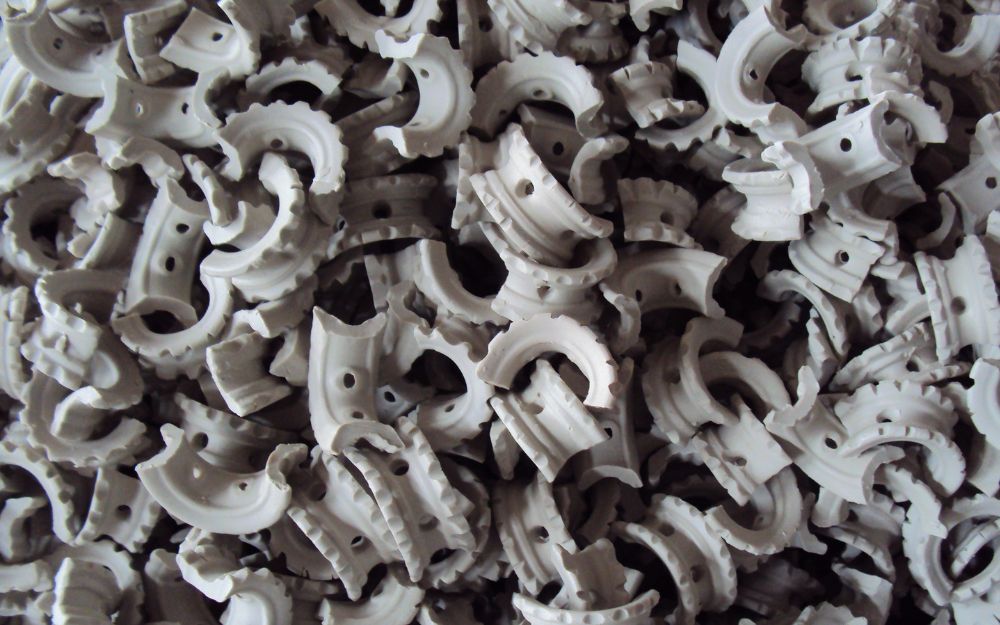
Over the years, manufacturers have developed a variety of different types of heat transfer media for Regenerative Thermal Oxidizer (RTO) use. These types fall into two basic categories: Random Packed and Structured. Each type provides different features and benefits related to thermal efficiency, VOC destruction efficiency, resistance to particulate fouling and plugging, installation cost, operational cost, and lifetime operating cost.
Random Packed Media
Initially (1970 – 1980), RTOs relied on a range of materials for heat recovery, including ceramic balls and gravel. Packing material was randomly placed (or “dumped”) into the oxidizer to create a heat recovery media bed. This haphazard placement was chosen to prevent nesting, which constricts flow and causes dead areas prone to particulate buildup. Eventually, RTO manufacturers and owners determined the best design shape for random packed media was the “saddle.”
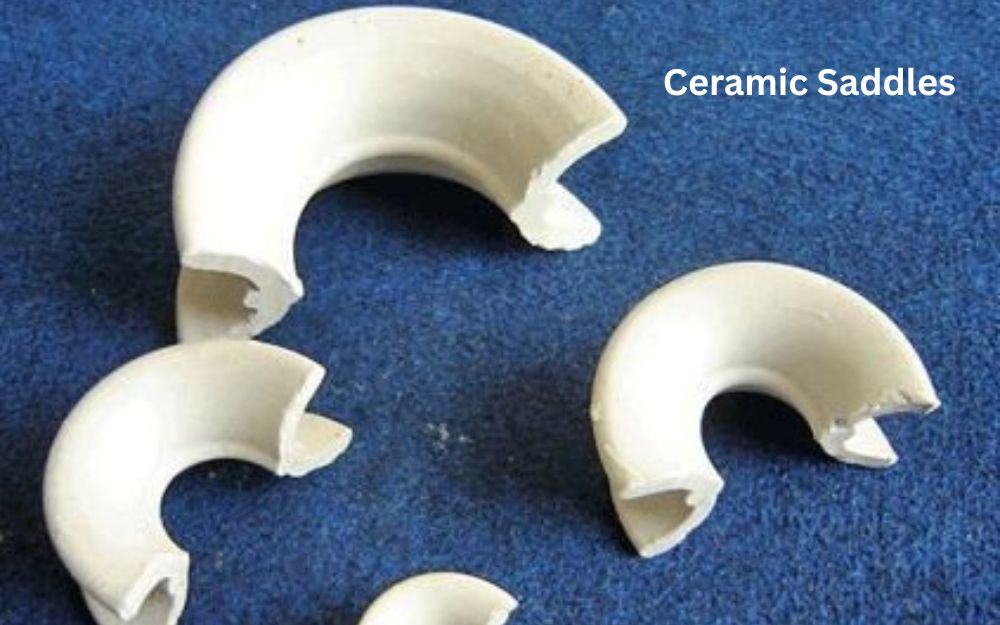
Saddles: Shaping the media like a saddle provides a good balance of high surface area for better heat transfer efficiency while maintaining lower pressure drop. Lower pressure drop reduces the fan’s use of electricity, reducing RTO operational costs. Saddles come in a variety of sizes, although 1” saddles are the most commonly used in RTOs.
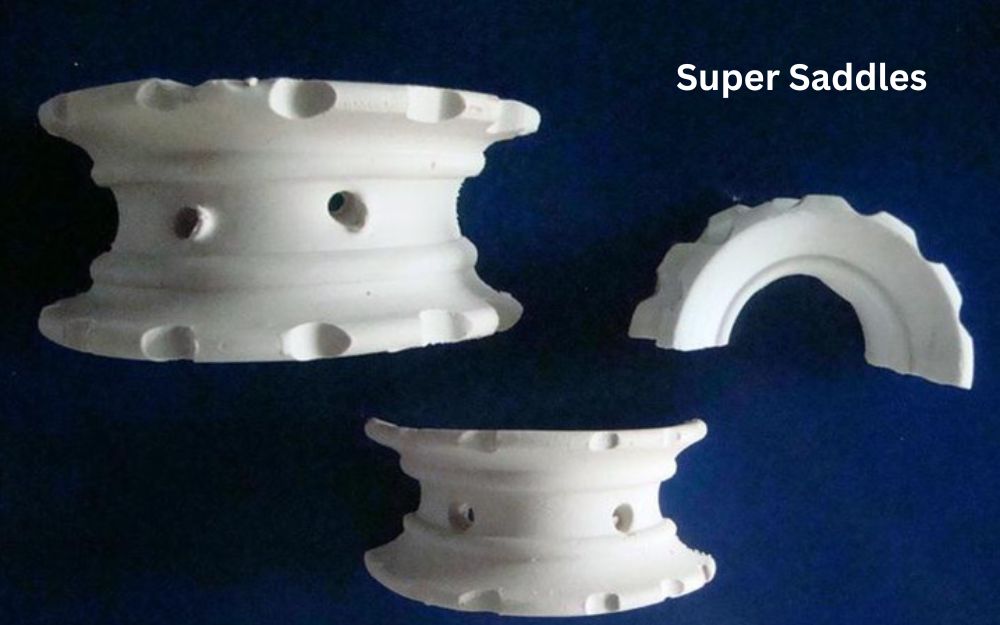
Super Saddles: Years later, this simple saddle design was refined further to provide more efficient heat transfer properties and reduce nesting. Today’s “super saddles” feature scalloped edges and a perforated design and are frequently used as high-performance packing for RTOs. Their surface offers high chemical resistance and better stability than traditional saddles. The fairly simple design of super saddles can make them a cost-effective choice for the right application and process conditions.
Structured Media
Structured heat exchange media is placed in a formal arrangement, rather than being randomly dumped. It is designed to pack a high density of ceramic into a small surface area while offering a lower-pressure drop. There are various types of structured media, including Monolith, Corrugated, and Multi-Layer.
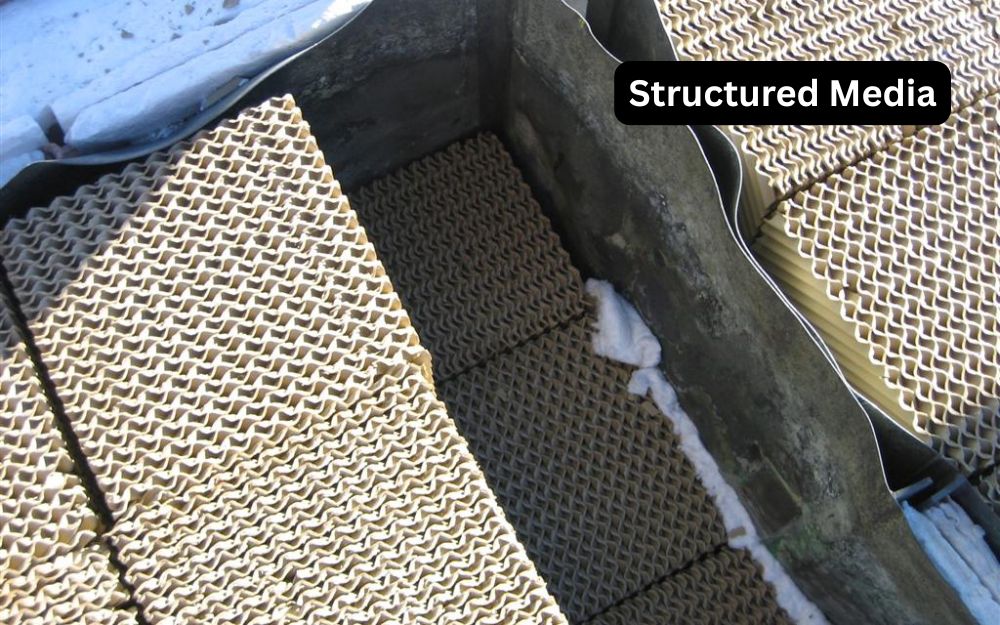
Monolith: Ceramic monolith is shaped as an extruded block, with cells extending through the block in a straight channel perpendicular to the “cold face” (where the inflow enters the block). The monolith design provides greater contact surface area to absorb heat and, theoretically, a more aerodynamic channel for the air stream. However, if particulate plugs a channel at the cold face, then the whole channel becomes a dead zone. As a result, monolith works best in RTOs with streams low in particulates or condensibles.
Corrugated Structured Media (e.g., Flexeramic®): This type of heat exchange media consists of corrugated ceramic sheets geometrically arranged to provide greater resistance to fouling. The angle of inclination of the corrugations of adjacent sheets is reversed to promote the consistent distribution of airflow throughout the bed and prevent dead zones. Design characteristics allow air to channel through the bed multiple ways even as it begins to plug in one channel. Although it may cost a little more to install, corrugated structured packing should be considered when particulates or condensibles are of concern.
Multi-Layer Structured Media (“MLM”): Newly designed MLM consists of loose plates with no internal stress points, and can be constructed of lower-cost chemical porcelain vs. more expensive high-silica ceramic (like with Monolith). Under the right conditions, MLM may offer good heat capacity, pressure drop, and thermal efficiency when compared to other types of ceramic media. However, MLM can be fragile and less resistant to thermal breakage, and its flow-path design characteristics can make it less resistant to fouling.
Unsure what’s best for your RTO?
If you’re unsure of the best solution for your RTO, call us. Our technical experts can recommend the right ceramic media product and configuration for your system, application, and process conditions. Learn more about our ceramic media services, including full-scale media replacements.